Sizes & Specs
The deep reference: dimensions, capacities, entry types and weight classes — plus how to actually choose.
Spec'ing a load?
Not sure which size fits your racking or your product? Send the details and we'll spec it with you.
- ✓ Reused-first inventory, graded honestly
- ✓ Zero-to-landfill processing loop
- ✓ Regional pickup & delivery on our fleet
Standard pallet sizes, side by side.
The 48×40 GMA dominates North America, but global supply chains run on a whole family of footprints. Here's the lineup we stock and source.
| Standard | Inches | Millimeters | Region | Typical use |
|---|---|---|---|---|
| GMA / North American | 48 × 40 in | 1219 × 1016 mm | USA | Grocery, general freight — the most common pallet in the U.S. |
| Euro EPAL 1 | 47.2 × 31.5 in | 1200 × 800 mm | Europe | European logistics & retail standard. |
| Square (Drum) | 42 × 42 in | 1067 × 1067 mm | USA | Drums, paint, telecom. |
| Half / Display | 48 × 20 in | 1219 × 508 mm | USA | Retail display & DSD. |
| Beverage | 36 × 36 in | 914 × 914 mm | USA | Beer, soda & beverage. |
| Asia Standard | 43.3 × 43.3 in | 1100 × 1100 mm | Asia | Asian export & shipping. |
| Military (MIL) | 40 × 48 in | 1016 × 1219 mm | USA | Defense & heavy industrial. |
| Industrial (Block) | 48 × 45 in | 1219 × 1143 mm | USA | Automotive & chemicals. |
Don’t see your footprint? We build custom dimensions from reclaimed lumber. Ask us →
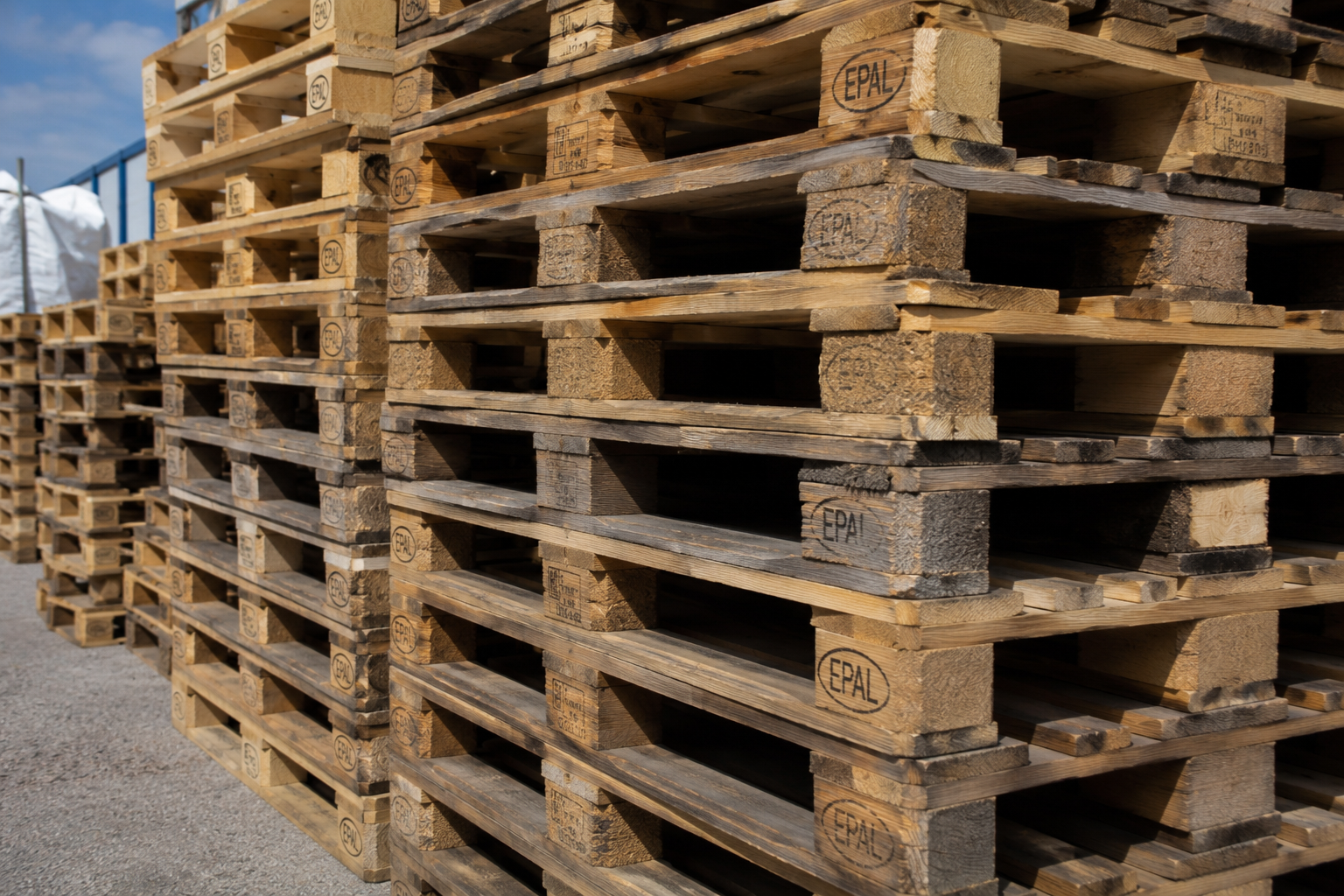
The EPAL mark, up close.
A pallet's stamps are its passport — standard (EPAL, GMA), treatment (HT for heat-treated / ISPM-15), and the facility that built or repaired it. Learn to read them and you can spec, source and audit with zero ambiguity.
How much can a pallet really hold?
Three numbers matter — and they're not the same. Confusing them is how product ends up on the floor.
Static load
Weight a pallet holds at rest, stacked on the floor.
Dynamic load
Weight it carries while being moved by fork or jack.
Racking load
Weight it holds when edge-supported in racking.
Figures are typical ranges for standard 48×40 hardwood pallets; exact ratings vary by construction and grade.
2-way, 4-way, and why it matters.
2-way entry
Forks enter from two opposite sides. Common on stringer pallets — economical and strong along the stringer.
4-way entry
Forks and pallet jacks enter from all four sides. Standard on block pallets — ideal for tight, automated docks.
Partial 4-way
Notched stringers allow forklift access on all four sides, but pallet jacks only on two. A practical middle ground.
Grades change the spec too.
Dimensions tell you if it fits. Grades tell you how many trips are left and how it'll look doing them. Read both before you order.
Specs & standards articles.
Got pallets to move? Let’s loop them.
Buying, selling, recycling or shipping — one short form and a real person gets back to you fast.